Science Tables for Thrid Graders to Read and Analyze
Equally an simple teacher, science and social studies were the subjects I struggled to teach well. I put so much time and try into making sure my students were receiving differentiated reading and math didactics that there was very picayune free energy left to create materials for science and social studies with the aforementioned rigor. We as well had a lack of materials for those subject areas, and then they took more work plan. Can you chronicle?

This past year, a friend and I created these Third Course Scientific discipline Stations (link to TpT) that cover all the Side by side Generation Science Standards for Third Grade. Hither are the domains and standards for each set of stations equally well as links to each set up.
Tertiary Grade Science Station Topics
Concrete Science
✔ Strength & Move – NGSS three-PS2.A
✔ Static Electricity & Magnetism – NGSS three-PS2.B
Life Science
✔ Life Cycles: Plants and Animals – NGSS three-LS1.B
✔ Ecosystems: Animal Group Behavior & Interactions – NGSS three-LS2.D
✔ Inheritance and Variation of Traits – NGSS three-LS3.A and 3-LS3.B
✔ Ecosystems and Biodiversity – NGSS 3-LS2.C and 3-LS4.D
✔ Plants & Animals Long Gone – NGSS iii-LS4.A
✔ Natural Option & Adaptations – NGSS three-LS4.A
Globe Science
✔ Weather condition & Climate – NGSS 3-ESS2.D & NGSS 3-ESS3.B
Each set of science stations is built the aforementioned mode with 8 separate scientific discipline stations that approach the standard and topic slightly differently and require students to do a different kind of work.
-
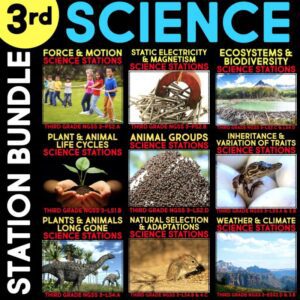
Tertiary Grade Science Stations BUNDLE
Product on auction
$118.84
-

Ecosystems: Beast Group Behavior Third Grade Science Stations
$13.78
-

Inheritance & Variation of Traits Third Form Scientific discipline Stations
$13.78
-

Ecosystems and Biodiversity Tertiary Grade Science Stations
$13.78
-

Plants and Animals Long Gone Third Grade Scientific discipline Stations
$13.78
-

Natural Pick and Adaptations Third Form Science Stations
$13.78
-

Forcefulness and Motion Third Grade Science Stations
$13.78
-

Static Electricity and Magnetism 3rd Grade Science Stations
$thirteen.78
-

Life Cycles: Plants and Animals Third Course Scientific discipline Stations
$13.78
Scientific discipline Stations
► Sentinel a Video – Students picket a video about the concept and answer questions.
► Play a Video Game – Educatee interact with a video game about the concept. They and so respond to questions almost their feel.
► Investigate – Students investigate the concept and respond questions.
► Diagram – Students diagram about the concept and answer questions about it.
► Read a Passage – Students read a passage and reply questions near the concept.
► Model – Students model the concept and respond questions virtually their models.
► Explore – Students explore the concept and questions about it.
► Sort – Students do a sort about the concept and explain their reasoning.
Some of the stations include more than one action or extensions. These are groovy for early finishers or students who want to dig a little deeper into the concept.
Differentiated Responses
Each station includes four different ways to reply to the experience at the station:
- short answer questions
- fill-in the bare questions
- task cards with short answers
- chore cards with multiple choice
All the variations are like to ane another, but require a different level of independence. The fill-in-the-bare is the easiest and perfect for your students who struggle with reading, specially if you provide them with a give-and-take banking company. The brusque answer is the about difficult as information technology requires students to construct their own responses without much support.
Choose the format that all-time fits your classroom and students. Students are also encouraged to use their science journal via the task cards. Reply keys are included for all of the differentiated response formats.
Some activities also include a worksheet in add-on to the differentiated responses. This worksheet is the "work" of the station. The differentiated responses require students to think broadly almost the topic and concept.
In the photos beneath you lot'll see examples of the four types of differentiated responses.
An In-Depth Wait at the Third Grade Science Stations
Below is information and details about each Scientific discipline Station. The examples below are from the Ecosystems and Biodiversity Scientific discipline Stations which address NGSS three-LS2.C and 3-LS4.D and includes concepts such nutrient chains, food webs, traits of organism alter due to environmental changes, how animals bear on their environment, invasive species, and biomes.
Vocabulary Cards

Included are two types of vocabulary cards. Ane set is three-part vocabulary cards that tin can become a separate matching station, if you need 9 stations or if you have before finishers at some of the other stations.

The other set of vocabulary cards are but the give-and-take and definition. These are great for a give-and-take wall or pocket nautical chart that y'all brandish for the unit.
Watch a Video
In this station, students apply a computer to scout a video about the science topic. Some videos need a computer and some videos can be accessed using a tablet or other device. Those that can be accessed via device also include a QR Code.
Later watching the video, students answer questions about what they watched on the worksheets or in their scientific discipline journals. The informative videos that we have called for these science stations go in-depth about the topic and concepts but are also accessible to a wide range of student abilities.

For most science stations, we have provided ii different videos to scout. You lot can let students choose which video to picket, assign one of the videos or have one video be an extra science station, if you need more options. Each video comes with it's own set of differentiated responses.
Play a Video Game
Do your students dearest playing video games as much equally mine do? Although I can't promise that these videos will be as engaging as some games played at home, they will be educational!
In this station, students play a video game on the figurer. The video game or the direction worksheet guides students through the game and has them respond to prompts along the way. At the conclusion of the game are differentiated reflection questions well-nigh the concepts learned in the game.

Investigate
The investigations vary across science stations and topics. Generally the investigation includes a curt text passage, easily-on activity, a worksheet to reply to the hands-on experience and differentiated questions.
In this specific investigation, students are exploring why certain colors of bugs get eaten more often than other colors of bugs. Non photographed are the differentiated student responses.

Diagram
In the Diagram station, students create a diagram about the concept. At that place is often a reading passage every bit well as a worksheet to go with the activity.
In the Ecosystems and Biodiversity set of stations, students read about the Otter Nutrient Concatenation, diagram it, then fill out a graphic organizer outlining the cause and effect relationship of each organism in the nutrient chain. In improver to the worksheet are a set of differentiated responses.

Read a Passage
In this department, students read a passage, unremarkably 1-2 pages in length, about a topic related to the concept. The passages has subheads and most passages have pictures to accompany them. After reading the passage, students answer a set of the differentiated response questions. Pictured below is the full-in-the-bare response.

Model
Model is another station that generally has a easily-on component to it, similar Investigate and Explore. In Model, students either create or analyze a model related to the topic. Often there is a related text with the activity.
In this example, students read a couple paragraphs about deforestation and and then identify which sentences depict the pictures that illustrate a rainforest, deforestation, and conservation. In improver to the activity are differentiated response questions in the formats in a higher place.

Explore
The explore station asks students to look at the concept and topic at a deeper level by exploring one attribute of information technology. The explore station will either have a easily-on activity or a reading passage with a worksheet that has students draw conclusions and explain their thinking. Like all the other stations, there are four ways to respond to the exploration.
In this particular station, students explore 5 unlike invasive species and explain what happens to the environment every bit a result of their introduction. Pictured is the worksheet every bit well as the differentiated responses.

Sort
The sort station has students sort organisms or something related to the topic. The sort is oftentimes accompanied past a reading passage and may include additional reading on each sort card. The sort is bachelor as a cut and paste activity similar you come across below every bit well as a total-color bill of fare sort.
In the picture, students sort organisms into different biomes using the moving picture and details in the bullet points. Non pictured are the differentiated student responses.

What Others Are Saying
Below is feedback from classroom teachers on Teachers Pay Teachers:
Jamie said:
WOW!!! This is an astonishing resources that is really helping me to plan according to NGSS standards. My 3rd graders honey the diversity of activities that really help them empathise scientific topics at a deep level. I dearest how easy these stations are to implement and plan! Give thanks you for an astonishing resource.
Sara said:
This bundle is going to brand SUCH a difference in my classroom this yr!! We have adopted the NGSS, so this pack is going to help me plan tremendously. The activities included are going to help my students understand what the standards are asking of them in unique and fun means. The different stations are going to encourage all kinds of levels of thinking, which is going to be great to sit back and sentry. Thanks for putting such effort into this fix of resources. The depth of each resource is backed by so much inquiry on your office, so I cannot wait to see my students flourish and grow at every stage of the work nosotros complete! Thank you, thank you lot, thank you.
Laura said:
With new NGSS standards implemented this year, and limited resource, this was perfect!! The activities, information, and system was very articulate and engaging for students. This covers all that I need to teach science to tertiary grade!!
Teresa said:
I love the higher level thinking strategies that went into this product. We are using the Adjacent Generation Standards and this is the perfect mix for my students. Higher level thinking, awarding of the information in different learning modalities. This is going to help my kids a neat deal. I have never been disappointed with any materials that I have purchased through you and I greatly capeesh that my teacher dollars are going to something meaningful and helpful to my kids. Thank you!
How to Purchase
Yous tin can buy the Third Grade Scientific discipline Stations on my web site or on Teachers Pay Teachers. There is a class-level bundle, sets by standard, and each station is available individually as well.
Here are links to each ready:
Physical Science
✔ Force & Motion – NGSS 3-PS2.A
✔ Static Electricity & Magnetism – NGSS 3-PS2.B
Life Scientific discipline
✔ Life Cycles: Plants and Animals – NGSS 3-LS1.B
✔ Ecosystems: Animal Group Behavior & Interactions – NGSS 3-LS2.D
✔ Inheritance and Variation of Traits – NGSS 3-LS3.A and three-LS3.B
✔ Ecosystems and Biodiversity – NGSS iii-LS2.C and 3-LS4.D
✔ Plants & Animals Long Gone – NGSS 3-LS4.A
✔ Natural Selection & Adaptations – NGSS 3-LS4.A
Earth Science
✔ Weather & Climate – NGSS 3-ESS2.D & NGSS 3-ESS3.B
-
Third Grade Science Stations Package
Product on auction
$118.84
-
Ecosystems: Creature Group Beliefs Third Grade Science Stations
$13.78
-
Inheritance & Variation of Traits Third Grade Science Stations
$13.78
-
Ecosystems and Biodiversity Third Grade Science Stations
$13.78
-
Plants and Animals Long Gone Third Class Scientific discipline Stations
$xiii.78
-
Natural Pick and Adaptations Third Class Scientific discipline Stations
$thirteen.78
-
Forcefulness and Motion 3rd Grade Science Stations
$13.78
-
Static Electricity and Magnetism Third Class Scientific discipline Stations
$13.78
-
Life Cycles: Plants and Animals Third Grade Scientific discipline Stations
$13.78
Would yous like a Free Science Station?
I have a set of free science stations for 2nd, 3rd, and 4th. Click here or the paradigm below to access them.


Source: https://www.whatihavelearnedteaching.com/third-grade-science-stations/
0 Response to "Science Tables for Thrid Graders to Read and Analyze"
Post a Comment